From collection Great Cranberry Island Historical Society Collection

Page 1
Page 2
Page 3
Page 4
Page 5
Page 6
Page 7
Page 8
Page 9
Page 10
Page 11
Page 12
Page 13
Page 14
Page 15
Page 16
Page 17
Page 18
Page 19
Page 20
Page 21
Page 22
Page 23
Page 24
Search
results in pages
Wilfred Bunker Interview Transcript 5th Dec, 2011
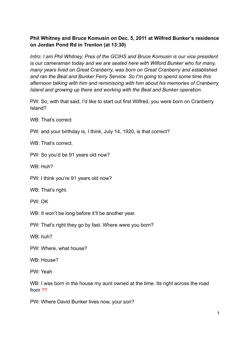
Phil Whitney and Bruce Komusin on Dec. 5, 2011 at Wilfred Bunker's residence
on Jordan Pond Rd in Trenton (at 13:30)
Intro: I am Phil Whitney, Pres of the GCIHS and Bruce Komusin is our vice president
is our cameraman today and we are seated here with Wilford Bunker who for many,
many years lived on Great Cranberry, was born on Great Cranberry and established
and ran the Beal and Bunker Ferry Service. So I'm going to spend some time this
afternoon talking with him and reminiscing with him about his memories of Cranberry
Island and growing up there and working with the Beal and Bunker operation.
PW: So, with that said, I'd like to start out first Wilfred, you were born on Cranberry
Island?
WB: That's correct
PW: and your birthday is, I think, July 14, 1920, is that correct?
WB: That's correct.
PW: So you'd be 91 years old now?
WB: Huh?
PW: I think you're 91 years old now?
WB: That's right.
PW: OK
WB: It won't be long before it'll be another year.
PW: That's right they go by fast. Where were you born?
WB: huh?
PW: Where, what house?
WB: House?
PW: Yeah
WB: I was born in the house my aunt owned at the time. Its right across the road
from ??
PW: Where David Bunker lives now, your son?
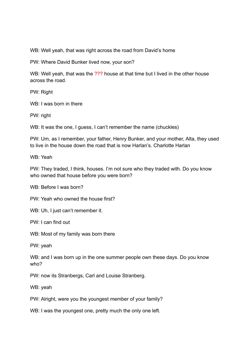
1
WB: Well yeah, that was right across the road from David's home
PW: Where David Bunker lived now, your son?
WB: Well yeah, that was the ??? house at that time but I lived in the other house
across the road.
PW: Right
WB: I was born in there
PW: right
WB: It was the one, I guess, I can't remember the name (chuckles)
PW: Um, as I remember, your father, Henry Bunker, and your mother, Alta, they used
to live in the house down the road that is now Harlan's. Charlotte Harlan
WB: Yeah
PW: They traded, I think, houses. I'm not sure who they traded with. Do you know
who owned that house before you were born?
WB: Before I was born?
PW: Yeah who owned the house first?
WB: Uh, I just can't remember it.
PW: I can find out
WB: Most of my family was born there
PW: yeah
WB: and I was born up in the one summer people own these days. Do you know
who?
PW: now its Stranbergs, Carl and Louise Stranberg.
WB: yeah
PW: Alright, were you the youngest member of your family?
WB: I was the youngest one, pretty much the only one left.
PW: Yeah, you were the youngest one, is that right?
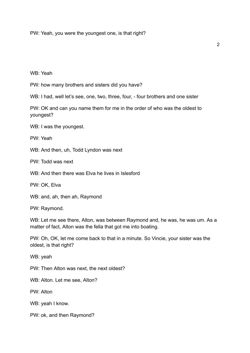
2
WB: Yeah
PW: how many brothers and sisters did you have?
WB: I had, well let's see, one, two, three, four, - four brothers and one sister
PW: OK and can you name them for me in the order of who was the oldest to
youngest?
WB: | was the youngest.
PW: Yeah
WB: And then, uh, Todd Lyndon was next
PW: Todd was next
WB: And then there was Elva he lives in Islesford
PW: OK, Elva
WB: and, ah, then ah, Raymond
PW: Raymond.
WB: Let me see there, Alton, was between Raymond and, he was, he was um. As a
matter of fact, Alton was the fella that got me into boating.
PW: Oh, OK, let me come back to that in a minute. So Vincie, your sister was the
oldest, is that right?
WB: yeah
PW: Then Alton was next, the next oldest?
WB: Alton. Let me see, Alton?
PW: Alton
WB: yeah | know.
PW: ok, and then Raymond?
WB: Yeah
PW: and then Alva?
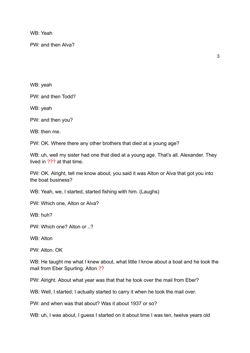
3
WB: yeah
PW: and then Todd?
WB: yeah
PW: and then you?
WB: then me.
PW: OK. Where there any other brothers that died at a young age?
WB: uh, well my sister had one that died at a young age. That's all. Alexander. They
lived in ??? at that time.
PW: OK. Alright, tell me know about, you said it was Alton or Alva that got you into
the boat business?
WB: Yeah, we, I started, started fishing with him. (Laughs)
PW: Which one, Alton or Alva?
WB: huh?
PW: Which one? Alton or ..?
WB: Alton
PW: Alton. OK
WB: He taught me what I knew about, what little I know about a boat and he took the
mail from Eber Spurling. Alton ??
PW: Alright. About what year was that that he took over the mail from Eber?
WB: Well, I started; I actually started to carry it when he took the mail over.
PW: and when was that about? Was it about 1937 or so?
WB: uh, I was about, I guess I started on it about time I was ten, twelve years old
PW: Oh, OK, so probably about 1930 or 32 then?
WB: Yeah
PW: Oh very early, yeah.
4
WB: We took it over just as soon as it changed from Eber to him. Alton took it over
until he passed away. Then I took it over, after that. Then I went in the Merchant
Marines.
PW: OK. When did Alton pass away?
WB: Huh?
PW: When did he pass away?
WB: Alton?
PW: Yeah
WB: Oh, he had a heart attack and fell down the stairs and Oh I don't know, I was
old enough to know better.
PW: But it was before
WB: I'm going to guess, you can look on his stone down in the graveyard. You can
tell you right when he came out of it(??)
PW: OK. But it was before you went in the Merchant Marine right?
WB: uh, let me see, I went in the Merchant Marine, yeah, yeah, I was in the, I was
carrying the mail for Alton He was carrying the mail, he was tending it (??). He took it
over and uh, his eyesight was bad and he couldn't see too good to deliver/tell (??) so
he told me, when I went out fishing with him and trowel fishing One day we went off
in the Dory (??) 8:50 - He got so far off, Alton couldn't see him. I am(?) able to keep
track of it and we got back in alright. But, uh, his eyesight was very bad. He couldn't
see good at all. Matter of fact, one day I was coming over to Seal Harbor and there
was a couple, three ??? in the old ??? we had I was running her into Seal Harbor
??? 9:39 We got about half way across then ??? 9:48. (Laughter) They said to him
"Alton, hadn't you ought to be watching this compass, son?" He said, "No he go
alright." (Laughter)
PW: He couldn't see it
WB: He couldn't tell it what he was doing. You know, he knew what he was doing but
to pinpoint it, he couldn't do it. His eyes were bad.
PW: So, in those days, the mail run then went from the Cranberry Isles to Seal
Harbor, right?
WB: That's right
PW: That's during the 1930s now we are talking about.
5
WB: That's right. My father carried it from in Seal Harbor when it first started. Then
Eber took it over from him.
PW: Oh, I see. And then so Eber would have given it up about the time you were 10
or 12 years old around 1933 or 2, somewhere in there. Is that right?
WB: yeah
PW: OK
WB: | was about 19, I guess about 18, I guess I graduated from High School
19...
PW: around 1938 maybe? You would have been about 18
WB: I think it was 38.
PW: yeah. So that, that would be when officially Eber gave up the contract?
WB: that's about the time I took the mail over.
PW: that's when you took it?
WB: Alton took it. ????? 11:30
PW: What kind of a boat did you use back then?
WB: what did I use?
PW: or Alton
WB: He had a double ? of his own. And then he bought one, took one of the
Rayburn's boats and I can't expect that I remember too much about it. ?? (12:09)
PW: did it have an inboard engine?
WB: huh?
PW: Did it have an engine, an inboard engine?
WB: Yeah. First one Alton had was a single cylinder, oh, one of the old, um,
I
can't
remember..
PW: OK that's no problem, So let me ask you this, especially in the wintertime, this
was year round you were taking the mail to Seal Harbor, there must have been some
pretty heavy seas out there, once you get out between Sutton's and Islesford
heading toward Seal Harbor, right. It must have been pretty
6
WB: (12:57-13:01 ??)
PW: yeah, but after you took over it must have
WB: well, when I took over, well right after Alton died, and
PW: You still ran it to Seal Harbor
WB: Yeah we run it from Seal Harbor to for quite a few years then changed to
Southwest Harbor. For a time we was there in Southwest Harbor then we went to
Northeast Harbor.
PW: Right, when did it switch to southwest Harbor from Seal Harbor, do you
remember?
WB: When was it??
PW: When did you switch from Seal Harbor to Southwest Harbor, the mail?
WB: Well, let me see. It had to be somewhere about by the time I was, when I first
started. I guess it was Todd was went with uh, with Linden. He went and Elmer for,
during one winter. It was the last winter I was in high school (?) then I went from
there. I went onto the mail boat then. I stayed on it until I got off. (chuckles) and went
into the Merchant Marines. I was in there 2 years, almost 3. From then on I been in
there, been in on all the time.
PW: So, it was sometime in the late 1930s then that you started going to Southwest
Harbor, right?
WB: Yeah, I think it was about 1930.
PW: OK
WB: I graduated from high school
PW: Around 38
WB: Around 38. And I started right after that for running the mail from Alton. Then I
took it over after he passed away. And then I been into it ever since.
PW: OK. We will come back to Merchant Marine and everything after that in a minute
but I want to ask you a little bit um, what was it like growing up on Great Cranberry in
the 1920s and 30s? Is there anything you would like to tell me?
WB: It was, was good going. Was two teachers and all the
7
PW: Two teachers in the school
WB: Yeah, It was somewhere about, uh, don't know, it was 6 to 10 children in
grammar school.
PW: That would be in each class?
WB: Yeah
PW: In other words, there were 2 teachers and each teacher would have 6 to 10 kids
WB: Yeah, the first one was for four grades,
PW: Yeah
WB: And the rest with the other one.
PW: OK. alright, what else would you like to say about growing up on Cranberry?
WB: Well, I had a lot of fun (chuckes)
PW: A lot of fun. (Laughter) Tell me some stories.
WB: Huh?
PW: Tell me some stories. How did you have fun?
WB: Well, we used to go deer hunting. You'd throw them 'em at the ones that got the
deer, we'd throw mud at them. And that was particularly a lot of fun. And we used to
use, up there on old schoolhouse hill. We had sleds going on there all the time. The
teachers would go sliding with us. Yeah, we had a good time. An every once in a
while we'd have a, um, after I got old enough, I got mixed up in card playing, and
used to play with us cards there every first of the week.
PW: Where would they play?
WB: Huh?
PW: Where would they play cards?
WB: In the schoolhouse
PW: In the schoolhouse?
WB: Yeah
PW: Would that be upstairs?
8
WB: Yeah
PW: Yeah. OK
WB: It was anywhere from, oh anywhere from 10 to 20, play cards, once or twice a
week.
PW: Was this year round or just in the winter time?
WB: It was in the year round
PW: Uh-huh
WB: Pretty much, and more so in the winter. Play for, ??, somebody would win and
somebody would be losing and it's like anything else. But uh, when uh, my wife's, not
my, my sister's husband, he was superintendent of school and put a padlock on that
time.
PW: That was uh, Vincie, your sister, married Charles Halbert, right?
WB: That's right.
PW: And he was superintendent of schools.
WB: Yeah. And
--BREAK--
PW: Bruce, what did you want to ask?
BK: I wanted to ask, since there's heat has been installed upstairs in the school now
lately and there wasn't any heat there before, how did they play cards up there and
stay warm?
PW: OK. What Bruce was asking - are you recording?
BK: Yeah
PW: Ok, how did they heat the upstairs in the old days?
WB: How'd they what?
PW: How did they heat it in the winter time? Keep it warm?
WB: Yeah, Woodstove.
PW: They had a woodstove upstairs?
9
WB: Oh yeah.
PW: And a pile of wood.
WB: Yeah. Wood and coal. ???, they have coal all the time down the (cellar?) I
started boating coal when I did first got into boating. And have 12 to 14 ton every
year and we had to bring it down every year in hundred pound bags (chuckles)
PW: And bring from the boat to the school?
WB: Yep. We picked it up in Southwest and by the, uh, what it was named? Uh
PW: J.N. Mills maybe?
WB: Huh?
PW: J.N. Mills?
WB: Mills, yeah.
PW: Where Downeast Diesel is now is where they are located.
WB: Huh?
PW: Where Downeast Diesel is now in Southwest Harbor is where J. N. Mils was
WB: Yeah, yeah
PW: Yeah
WB: Yeah there is Downeast Diesel there and is also, uh
PW: It was later Manset Marine
WB: Well, Manset Marine and ???, they had, they ran a damn good shop and then
they went into Rockland and went back and forth
PW: OK, OK this is with Manset Marine?
WB: Yeah, they were very good to do business with
PW: Yeah
WB: I mean there is a lot of stuff like that, if you hadn't mentioned, probably I
wouldn't have thought of it.
PW: Yeah, oh yeah. There is a lot of things I'll say with will trigger your memories I
think
10
and that's the whole idea of this. (chuckles) Anything else you remember about
growing up on Cranberry that stands out in your mind that you'd like to talk about? In
your early years?
WB: In the boats?
PW: Uh well anything about growing up on Cranberry. Before you
WB: I told you, we used to play deer hunting with mud, with spruce muds (chuckles)
PW: Who were some of your schoolmates or classmates in school?
WB: Huh?
PW: Who were some of the folks you grew up with on Cranberry?
WB: Well, Steven Spurling and Norman Wedge, a number of them. Wedges and
there's 12 or 15 in school - all the time and maybe more. And uh
PW: Uh-uh.
WB: And uh Thelma Teal was one of us older teachers. She was Dale Teal's wife.
She was the ??? teacher.
PW: She taught for many, many years, right?
WB: Yeah, the last I knew she was teaching in, uh, Swans Island I think.
PW: Oh
WB: I remember one particular day, when Tug was going back and forth quite often
and used to land at the dock down at Cranberry and climb a ladder. They had no
floats - had to climb the ladder.
PW: No steps either right?
WB: No, no steps before we - afterwards. But when I was a youngster Id bring the
mail down and I'd have the groceries and I'd have to go up on the dock, you know I
was all alone, lower my hook line down, go down the ladder and hook the boxes on,
go up on climb the ladder again, taken them up on the dock, put them in the truck.
PW: All year round, summer and winter, right?
WB: Yeah guess so I could, and uh I did it all alone most times. That's before
Clarence went in business with me. And uh, there is a lot of times I went up and
down that ladder
11
(Laughter) Always getting groceries. Then we'd pick the oil up when Clarence joined
with me. That was about, well let me see, he's
PW: Around 1950 maybe?
WB: Yeah, it was at least then I think. He was, he used to be a lobster fisherman and
he wasn't too far from my age at that time. He was maybe a little older. And he went
up, went up. He wasn't in the Merchant Marines. He went in, went in, uh, let me
see
PW: Navy?
WB: Oh he was a
PW: Marine?
WB: Oh, what was he, I ought to know.
PW: I think he was either a Marine or-
WB: What?
PW: He was a Marine wasn't he?
WB: What?
PW: A Marine, Clarence?
WB: Yeah
PW: He was a
WB: He come from down and east
PW: Yeah down around Beal's Island and Jonesport or somewhere.
WB: Yeah somewhere right down around that area.
PW: Yeah
WB: And then he come up with Andrew Alley and those people. They moved up, 3 or
4 of them. He was the ones to work with I'll tell ya. They had a hard job, well, one of
them, every year, in the fall of the year you'd see a tree coming out through the
woods. He's have it on his shoulder, either Mr. Alley, they'd come up with another
fellow. They'd buy it, take an ax and cut a tree and put it on their shoulder and you'd
see the trees coming out before you'd see them. And that's the way they got their
wood.
12
PW: Got their firewood? Yeah
WB: Got their firewood.
PW: Yeah, yeah.
WB: There's a lot of work, but he
PW: They are a lot of work, yeah.
WB: But uh, all in all, there was a pretty good chance you could, young fellows could
do anything the older fellows could do. They'd work their way into it. I remember
once I, when I was in grammar school I'd get up in the morning and go down to the
mudflats, dig clams for the, (chuckles) the place over in Bass Harbor and I'd get
nothing. Probably I'd get ten or fifteen dollars for two or three mornings work.
PW: Uh huh
WB: Before school.
PW: But you'd sell them over to Bass Harbor?
WB: Yeah, they, we used to, we had a way of going over there. I can't remember
how we got them over. Somebody took, uh, had a boat to run over there. Whether it
was Herby Spurling or who it was, I can't remember.
PW: And they what, would sell them to different people or was there one person who
would buy them all?
WB: No, no, there's, we sold them to the factory
PW: Oh, the factory
WB: And you didn't get nothing for it. I remember if I got five or ten dollars a week I
was lucky. (chuckles)
PW: Mmm, yeah. Ok
WB: And, it was quite of lot of fun, going right out and learning it, what you had to
learn. My brother Alton took me in the boats first. I used to go with Tug and Raymond
and all of them, but, uh, he was the one who really took me ??. He always told me,
"Go ahead," he says "Always, when, don't ever bother your compass." He says, "Go
with what the compass says, and go take your time and you put in the boat, in the
book how many minutes it took you to go a certain place, you had it in the book."
And that's the way Alton, what little bit I know of boats.
13
PW: Uh huh
WB: And I, there is a lot to it. And uh, I remember, I brought Alison Bunker a little
small boat up Weston, we went and brought it down around and he wanted it to use
it, buy it. He did but I was teaching him a compass and didn't fast catch onto it too
fast. So one day, I went up the ladder ahead of him, when I stopped on my landing
I
said "I'll let you come up soon as you ?? the compass." (chuckles) And he ?? it too.
But he, he worked pretty good in his boat. And uh, stuff like that I remember all pretty
good.
PW: How old was Alison then? At that time?
WB: Oh, he was, well he was just about, 4 or 5 years younger than I was I guess.
PW: Well, he was, yeah, he was about, yeah. He was born I think about 1930. About
10 years younger than you, I think.
WB: Yeah, pretty close.
PW: But, when he was learning the compass with you, how old would he have been?
WB: Me?
PW: When he was learning the compass.
WB: Oh, he learned the compass when he was in grammar school.
PW: Ok, ok
WB: When I bought the little boat for him, I taught him to learn the compass then. I
don't know if he forgets it ?? north.
PW: I don't know. I'm going to talk to him next summer and I'll find out. Because I'll
interview him too.
(laughter)
WB: Yeah, ask him about ? the compass from north to south.
PW: Alright. ok
WB: See what he comes up with
PW: Alright
(laughter)
14
BK: I wanted to ask, uh, who taught Wilford to swim?
PW: Did you ever learn how to swim? And if so, who taught you to swim?
WB: Huh?
PW: Did you ever learn to swim?
WB: No
PW: Never, there's your answer.
(laughter)
PW: A lot of the guys never learned to swim, is that right? In those days?
WB: Nearest I come to drowning was, wind in Spurling's Cove blowed the boat, oh
probably blowed 30-35 miles an hour down in there. And I went to put, well it was the
Island Queen I guess. I went to put her on the mooring and I had the skiff tied on the
stern so on the side of her, and I went up on the deck bow, had to haul the chain up
to get put in the bow. And about the time I get almost to the ?? forward I felt the rope
around the wheel, caught wrapped around and I didn't quite, couldn't quite reach the
vent(??) from where I was and I remember I was all alone, at night, and I was, I
pushed myself right up and I got ahold of the boat ??, and when | did I shook my leg
and damned if I didn't shake the rope off me. ?? went back around and come back
and put it on the mooring. It's after dark.
PW: Yeah, and windy
WB: 30-40 mile an hour winds.
PW: Yeah, all those years, you were lucky not to have more, more dangerous
situations
WB: Huh?
PW: Of all those years you were on the water its surprising you did not have more,
more dangerous situations or close calls.
WB: | had, I fell overboard one morning, one other time, right at the end of the, end
of our wharf on the side ? pylon and I see I was going to go so I just made it off so
that when I hit the water I hit the (chuckles) mooring pole | mean, then I clung on.
When | got my arm around it, that pylon I took off for the top (chuckles) and there
was, uh was, I can't remember, he was and English fellow that, he was uh, related
into eventually, Carey Alley and them, cousins in the same outfit. Anyway, the other,
the old fellow was
15
up there on the dock buying fish and he was right outside the door, just came out of
the building and I went overboard. He come running down the dock and when he did,
I came up over the dock before he got there.
(Laughter)
PW: Ah.
WB: | could get up the pylon pretty good then (chuckles)
PW: (chuckles) That's good. Alright.
WB: Stuff like that I remember.
PW: You uh, when did you go into the Merchant Marines? Do you remember what
year? Was it before World War II actually started?
WB: Yeah well let's see, I graduated in '38
PW: And you graduated from Lee Academy is that right?
WB: Huh?
PW: Where did you go to school? Was it
WB: Patton Academy
PW: Patton Academy, then yeah.
WB: And uh, I left, uh my turn was coming up to get involved in the war so I
volunteered to run in the Merchant Marines.
PW: Was, had the war started at that time or did you join the Merchant Marines
before the war started?
WB: No, it was before it started
PW: Alright, so Pearl Harbor had happened and then you joined the Merchant
Marines.
WB: Yeah
PW: Yeah
WB: Well the reason I joined it, I looked the situation over and I went with the
Merchant Marines. I had a good meal every time. A good place to sleep and so I
didn't. It was actually, you might say, a draft dodger. (chuckles)
16
PW: Alright
WB: I went across ?? I had a very good time, and uh, I had a lot of experience. Well I
had a lot of small boat experience and when I went in there the third mate was uh, I
can't remember exactly where he was from but he joined, uh, we went into uh,
we
were in the, what, the first trip we took was down into the, oh, we was in, I can't
remember the name of the places, you know, so much now.
PW: Now are we talking down uh, here in the eastern US or uh least coast?
WB: I was in a small boat and um, the third mate and I worked together and uh, get
quite a lot of work at times. I remember, once we were putting the boat on the
mooring, it was quite a big skiff we had and we were just about ready to get aboard
the skiff and the damn deckhand on the, on top ? they pulled the rope and on the
?? picked them right up. I went from the top front and landed right in the stern.
PW: Ah.
(Laughter)
WB: And the funny part of it was, we just got ashore and we got a call from, that we
were wanted in, up in the Master's, wanted us to come up there and see the Master.
Well, I didn't know what we'd done. We went in and sat down and he said "I've been
watching you two fellas," and he said, "I never seen you work any better and get up
any better." He said "I think you ought to have a drink."
(Laughter)
WB: Don't neither one us drink so we thanked him for it and it was a good time. And
then shortly after that I had to go on ? I wanted to go up on the mast and paint the
outside of the uh working part of the mast. And I remember very plainly that I got up
in there and I said "what in the hell am I doing up here anyway?" And I'm painting
and you got to look down in the ocean ????. I guess it was one of the, yeah, one of
the workmen. It wasn't the, it was a - one of them old fellows that was in charge of
the boat. He said, "What are you doing up on there?" he said "You ain't supposed to
be up there." And I said "they told me to go up there and paint the rigging." And he
said, "You get down off of there. And don't you go back up there until you get word
from somebody who knows what they are talking about."
(Laughter)
WB: You could, I could roll right out and look down into the ocean and go back and
look right down the other side. I got it all painted just the same.
17
(Laughter)
PW: Now you
WB: That's the stuff that's the small boat had that you had ? to do something. And
one particular time, the, let me see, he was, he was in charge of getting stuff from
one ship to the other. And he comes down to me and he says, "You mind taking the
small boat and going up and getting the 5 gallons of oil they wanted?" on the other
boat. I rowed over and, I can't remember where it was, anyway, we had to get this
5
gallons oil paint back aboard for him. Well I said well, I'll go up there if the man who's
running that motor will run it the way I want it run. And he was, he come right aboard
and he says to the deckhand, the man who is in the engine room, he says, "I want
you to run this just as the captain wants to." And we went up through, right into, oh,
probably three-quarters of a mile ? come back down around made a circle and come
in. And uh, grabbed the ropes (chuckles) and we got it. Got out of there but it was a
real, was a tough spot to be in. Anyway, we got out, never got wet. (chuckles).
PW: Ah. Did a lot of the work that you did in the Merchant Marines was that involved
with convoys going across to Europe?
WB: The what?
PW: Convoys going across to Europe?
WB: Oh yeah. One time when it was down in uh, we was in one, it closed it right in,
with fog, and the boys done a hell of a job. They shut us right in the fog, then they
went in the far side of it and put up fire-ampiflare?
PW: Uh huh
WB: And they did a hell of a good job because they got to shooting at one side of it
and we were way over the other side and they didn't know where we was.
PW: Uh huh
WB: And we got out of that pretty good. It was quite an experience.
PW: So you made a number of trips back and forth across the Atlantic.
WB: I made uh 5 trips I think.
PW: Uh huh
WB: I was in, wait, I was in, um, I can't remember, I know it was in
18
PW: well we can always come back to this another time.
WB: I never paid too much attention to what the names of places were. I knew them
when I was there. But if somebody asked me afterwards I couldn't remember.
PW: But would you wind up going to England or France or
WB: Huh?
PW: What foreign countries would you go to?
WB: Oh we were in uh we come down out through into, uh where close to where
Italy.
PW: Costa Rica?
WB: Come down in one of the other parts down there then we wound up, up in uh
France I guess 3 or 4 different times. We were in one time there on the ship seeing
gunfire flying. It wasn't pointed at us. (chuckles)
PW: Where was this? In Italy or in France that you saw gunfire? Where, what
country was it you saw the gunfire?
WB: Huh?
PW: What country?
WB: It was uh, Italy or very close to Italy. And, I was trying to think of another place.
What was the place where they had the
It was in
I don't know I can't remember
now.
PW: That's ok. We will come back to it some other time.
WB: You'll have to come back 10 years ago, to remember anything ten years ago.
PW: Well, you remember eventually.
(Laughter)
WB: I'd probably remember some of it.
PW: So where you in the Merchant Marines for the entire war? All 4 years of World
War II?
WB: No, I was, I joined it out of high school. Around 19--, 19-- I don't know. I wasn't
more than probably 18 years old. Somewhere around there.
19
PW: And when did you get out of the Merchant Marines? When did you finish?
WB: When they stopped the war.
PW: 1945 about?
WB: Yeah I was over about in some part of England and we come across. I
remember the last trip I made across, coming back I was on deck-watch and I see
this little bit of a black thing back, way back in front of us and I kept watch of it. And
that was about maybe 9 o'clock in the morning. About noontime the ship passed us.
It was one of the English ships. Gone into Bar Harbor two or three times. Anyway,
we were cruising 9 naught and he was cruising about 25 (chuckles)
PW: Yeah.
(Laughter)
WB: A lot of things like that you remember but you don't remember the names.
PW: Sure, sure.
WB: What, imagining things, is not as smart as they used to be. (chuckles)
PW: Oh, you are doing fine.
WB: I couldn't remember everywhere I was.
PW: When you came back to Cranberry Island after World War II uh, when did you
get married to Norma?
WB: Oh I married Norma while I was in the war.
PW: You were married while you were in the war? So what year did you get married
to her?
WB: Geesh, that's a hard job to remember. I guess it was uh, I got married on the
about, I'd say I probably was 15, 16 something like that.
PW: Had you graduated from high school when you married her?
WB: Yeah, I was up in Patton, I graduated from Patton.
PW: Yeah, and then after that you married her right?
WB: Yeah that's about the time I married her. About the time I got done.
20
PW: Ok. And um, then you had three children obviously. You had Maryanne, and
Joyce and David were you children.
WB: That's right.
PW: And uh, Maryanne would have been born in the early 1940s I guess.
WB: Yeah I'd say so
PW: Yeah. And then Joyce was after her. So you had uh, two children, I guess, while
you were overseas in the Merchant Marines, right? You had two children back here
on Cranberry?
WB: Yup (nods head)
PW: Yeah. Ok.
WB: Yeah, Norma kept track (?) of the house and watched the kids.
PW: Yeah. Now your father Henry Bunker, he died around 1941?
WB: Linden? (??)
PW: Your father, uh, Henry.
WB: Yeah, he was, he died before, before Alton or any of the other boys died.
PW: He died before you went overseas. Before you went in the Merchant Marine,
right?
WB: Oh yeah.
PW: Yeah, yeah. So during the war then, Norma had your mother, Alta, and the two
children there at home on Cranberry, right?
WB: Yep.
PW: OK. Uh, ok. Let's uh, let me ask you a little bit about uh, who were some of the
other people on the island that you remember in the 1930s and 1940s? Other people
that lived on Cranberry and you knew.
WB: Well,
PW: Just any of your memories about them.
WB: Well, when I started ? it was about the time Lucius (?) Bunker give us a place
for the fire house and Clarence and | went down on Fish Point and took the house
the old
21
building there that Oscar Wedge and his people bought. He got through with it and
wanted to get clear of the building so I says to Clarence, "Let's take that, get the
lumber out of it, build a fire house " My god, we had ? We took it up around and
lugged it up and put it up where the fire house is now. And, course we had a lot of
the men folks saw what we was doing and stay here and help and we put that
building together and we had somebody that had, who knew something about
carpentry ?? we and built that building and we got a water truck from, oh, the one in
Southwest there used to ?? oil winter, oil and kerosene
PW: JM Mills again?
WB: Huh?
PW: JM Mills?
WB: Mills. And we kept quite a lot of the work all of the men. And I remember many
nights, Frances Spurling and Herby Spurling, ?? brothers painting inside of the fire
house. All put together ?? told us "you can have the building, as long as you use it
for fire house."
PW: Uh huh. What year was this about?
WB: That was, well I want, I hadn't been out of high school more than 2 or 3 years.
So we were, I remember, we had that old big, that old fire truck, water truck, and we
had this little engine on the back of it for pumping. And I remember the first house. I
was fire chief. I'd just been fire chief, about a year I guess and uh, um, the big white
house up there in, Milly Spurling was working on it
PW: Oh, the, where Micky MacFarlan lives?
WB: Yeah that's right. And then fire got up in there, in under the shingles. That's a
big house of course. It blowed a good breeze and I come back with the mail, into the
pool, Charlie Rice was us up on the roof trying to get the engine to work, the water.
And, he had a tricky old engine. I played with it enough. I know how to get it going.
Soon as I got there I got right up there with him. In no time we had the old water
going. We got the house up under the shingles and put it out. And if we hadn't,
Cranberry Island wouldn't be here. It would have gone.
PW: So this would have probably been in the middle to late 1940 that this happened
if Millard Spurling was working on that house.
WB: Yeah. That's who was working on it.
22
PW: That is when they were renovating the house I think. Because it was in real
tough shape, the house was, and right after the war and they, they uh, did a lot of
work to renovate it.
WB: Yeah
PW: Yeah. OK
WB: That's about the right time. About the same time.
PW: Tell me a little, what do you remember about some of your neighbors and things
there. Like Thelma and Sawtell Teal, or any of the other neighbors that you knew.
Anything you can think of.
WB: Sawtell was a nice old fellow but he'd get in a lot of mess sometimes, on the
boat.
PW: How was that?
WB: Oh, he, well he got (chuckles) he got some ?? on Suttons Island, ??
Viewer Controls
Toggle Page Navigator
P
Toggle Hotspots
H
Toggle Readerview
V
Toggle Search Bar
S
Toggle Viewer Info
I
Toggle Metadata
M
Zoom-In
+
Zoom-Out
-
Re-Center Document
Previous Page
←
Next Page
→
Wilfred Bunker Interview Transcript 5th Dec, 2011
This is a transcript of an interview Phil Whitney and Bruce Komusin conducted with Wilfred Bunker, the cofounder of Beal and Bunker, on the 5th December, 2011.
Details
07/20/2023