From collection Person
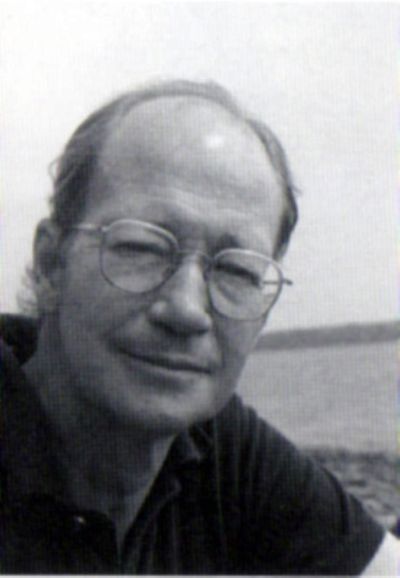
George Bunker was an artist who spent much time on Cranberry Island, living in a studio/house that he had built on the island. The following excerpt is from the booklet ‘Artists of Cranberry Isles’ written by Wini Smart.
“George Bunker bought land on Great Cranberry Island in 1963. In a field of wildflowers he had a new house/studio built, overlooking the Western Way. It’s an inspiring spot. Sunlight sparkles on the water, and sailboats and schooners pass by his windows. Maine is a refreshing change from the scenery at Houston, where he was Chairman of the Art Department, at the University of Houston.
“George was a worldwide traveler. When he was just out of school, his well-to-do parents paid for a two-year trip for him and his sister to Europe, Turkey, and Russia.
“They returned just as World War II was beginning. George enrolled in the Yale School of Art, but his studies were interrupted by a two-year overseas stint in the military. He won a purple heart for wounds received in the invasion of Italy. After finishing at Yale in 1946, he again traveled, this time in the U.S., Mexico, and Canada. Deciding to become an artist, he began additional art study at the Art Students League, in New York, and the Brooklyn Museum Art School. In the summer of 1947 he joined his mother, who was living in Florence, Italy, to study there.
“After teaching for two years, George again returned to Europe, studying lithography in Paris at the Académie Julien and the Académie de la Grande Chaumier. Still enamored with France, in 1950 he moved to Aix-en-Provence, Cézanne’s home. Thirteen years later he bought 18 acres in nearby Bibemus Quarry, where Cezanne had done much painting.
“It was there he met the Finkelsteins, who lived in that area for the summer. Ashley Bryan was there also, painting under the G.I. bill. Ashley remembers that George generously bought several of his paintings to help him out. The American artists were all very impressed with Cézanne’s paintings and followed his vision by painting in his footsteps.
“George’s early work was figurative and his landscapes had a definite Cézanne influence. In the 1960s he turned to Expressionism, which soon gave way to Abstraction. In his later life, he gave up all attempts to be realistic, working often in collage, reducing the subject to a few flat shapes of color.
“He started teaching at the Philadelphia College of Art in 1955, becoming Chairman of the Art Department. He resigned in 1973, to become Professor of Art and Chairman of the Art Department at the University of Houston. He stopped teaching in 1986 due to failing health. That same year the Houston Museum of Fine Art hosted a large exhibit with 45 of his paintings, collages, and drawings. George said, ‘I always felt an artist has an obligation to better the world.’ His life as philanthropist, teacher, and painter surely fulfilled that philosophy.”
Though Bunker passed away in 1991, he is remembered as a vibrant member of Cranberry Island’s community and an important figure in the legacy of artists that the island has inspired.
Related Items
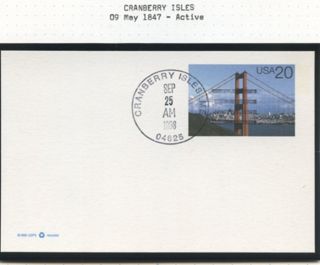
Pre-stamped postcard sent from the Cranberry Isles Post Office, 1998
Pre-stamped postcard sent from the Cranberry Isles Post Office, 1998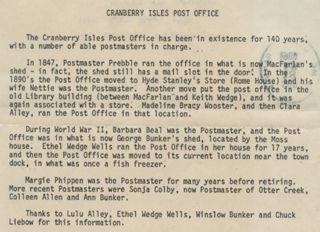
Brief history of the Cranberry Isles Post Office
Brief history of the Cranberry Isles Post Office
Artists of Cranberry Isles newspaper clippings
Collection of newspaper articles about Cranberry Island artists and happenings. Various years. unknown Donor